
Understanding the Hidden 40%: What Makes Up Your Energy Bill
When reviewing your energy bills, you might notice the total seems disproportionate to your usage.
There’s a reason for this: up to 40% of your electricity bill comprises non-commodity charges – costs not directly related to the electricity you consume.
Understanding these charges is essential for effective energy management and cost optimisation.
The 40% beyond your electricity consumption
While approximately 60% of your bill covers the actual electricity you consume (Supply Charge), the remaining 40% consists of various non-commodity charges that many businesses may not fully understand:
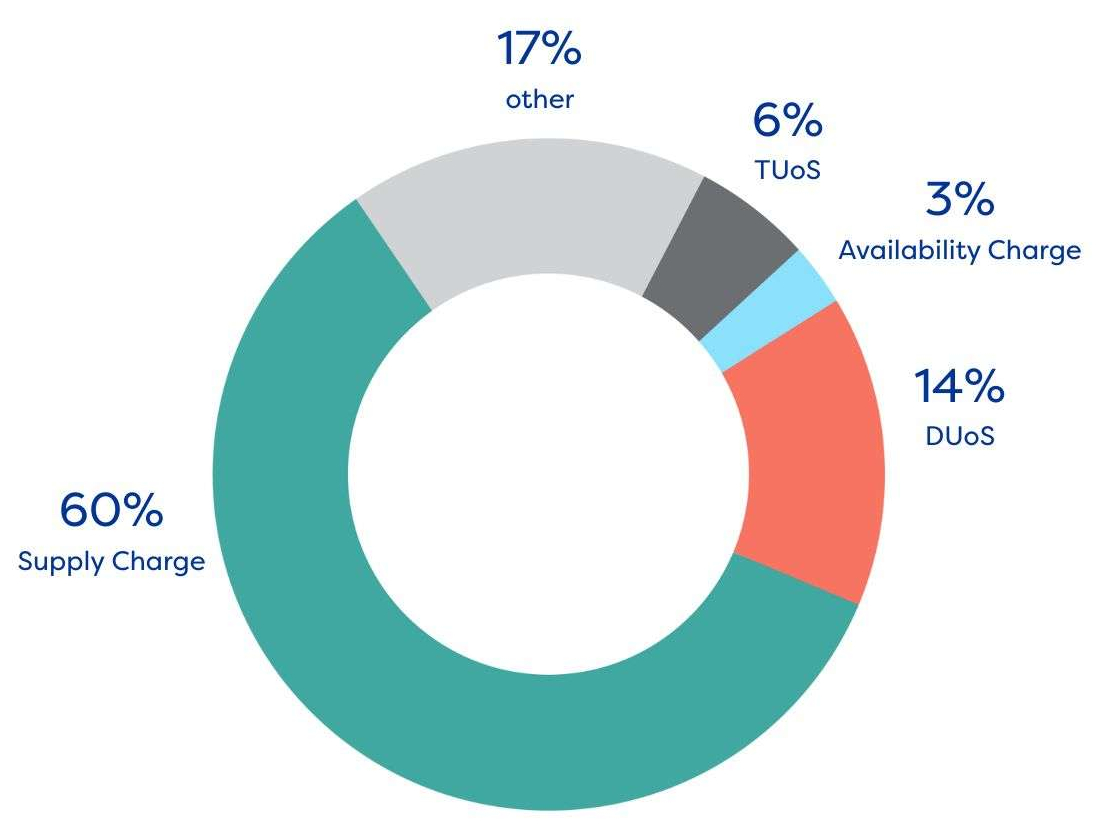
These charges fund the infrastructure that delivers electricity to your premises, yet they often receive less attention than consumption-based costs despite their significant impact on your overall expenditure.
Understanding Distribution Use of System (DUoS) charges
DUoS charges (approximately 14% of your bill) recover the cost of installing, maintaining, and operating local distribution networks.
These charges are passed on from your Distribution Network Operator (DNO) and vary significantly based on when you use electricity.
The Red, Amber, and Green (RAG) charging structure is designed to influence consumption patterns:
- Red Band periods (typically 16:00-19:00 on weekdays) carry the highest charges
- Amber Band periods (typically daytime and evenings) have medium-level charges
- Green Band periods (typically nighttime) have minimal charges
This structure means that identical consumption during different times can have dramatically different cost implications for your business.
Transmission charges and the Triad system
Transmission charges (TNUoS) recover the cost of installing and maintaining the National Transmission Network.
These charges, making up around 6% of your bill, are calculated using a distinctive methodology.
Your annual transmission costs are determined by your average demand during three specific half-hour periods between November and February — known as Triads.
These periods:
Your average demand during these three periods is multiplied by a regional rate to determine your annual transmission costs.
This means your consumption during just three half-hours can significantly impact your costs for the entire year.
Supply Capacity: Paying for what you might not use
Supply Capacity charges (about 3% of your bill) are based on the maximum electricity provision agreed between your site and the Distribution Network Operator.
You are charged for this capacity regardless of whether you fully utilise it.
This arrangement presents two potential inefficiencies:
If your capacity is set too high, you’re paying for capacity you don’t use
If your capacity is set too low, you’ll incur excess capacity charges at a higher rate
Optimising your Supply Capacity requires careful analysis of your actual usage patterns and consideration of future needs.
The value of comprehensive cost reporting
Given the complexity of these non-commodity charges, visibility into their composition and impact becomes essential for effective energy management.
Comprehensive cost reporting provides:
- Detailed breakdown of all charge components
- Identification of high-cost consumption periods
- Insights for optimising supply capacity
- Tracking of Triad performance
With this information, businesses can make informed decisions about when and how they use energy, potentially reducing costs without compromising operations.
Turning insight into action
With proper visibility into these charges, businesses can implement targeted strategies:
These adjustments can lead to significant cost savings without necessarily reducing overall consumption.
Taking control of your energy expenditure
In today’s complex energy market, understanding all components of your bill is essential for effective cost management.
The non-commodity charges that make up 40% of your bill should not be overlooked.
By gaining visibility into these charges through comprehensive cost reporting, you transform them from fixed costs into manageable expenses.
This understanding allows you to implement targeted strategies that can significantly reduce your overall energy expenditure while maintaining operational effectiveness.
Looking to gain clarity on your energy costs? Contact our expert team to discover more.
 Don’t miss out
 Don’t miss out
Stay in the loop with our news, events and more direct to your inbox

